Foreword Reviews interviewed PNW author, Alexandra Oliva in May Enjoy!
 Dontaná McPherson-Joseph Interviews Alexandra Oliva, Author of The Radiant Dark
Science and fiction—you can almost sense the tension between those two words. Science is serious, it wants evidence and facts. Fiction is playful, it imagines and creates and does whatever the hell it wants.
All of which makes the science fiction genre irresistible. The talent needed to hold those two opposing notions—science and fiction—together in the same literary work is surely proof of superior intelligence.
In The Radiant Dark, Alexandra Oliva delivers on that promise—Dontaná McPherson-Joseph’s starred review in Foreword‘s May-June issue confirms as much—and we were thrilled when Alexandra agreed to take a few questions from the reviewer’s probing mind.
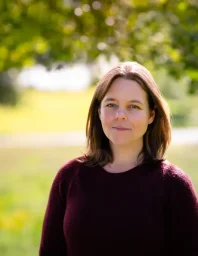
Photo: Maë Lans Photography
The Radiant Dark is about many things, but it is a novel of first contact. The Rossians, so named because their home planet is known to Earth as Ross 128 b, reach out with a repeating pattern of flashing lights. Have you always been interested in space and the idea of humanity not being the only intelligent life in the universe? How did this idea come to you?
I grew up in a beautiful, rural mountain town that had the most incredible night skies, and while I never had much interest in memorizing constellations, I loved to find my own patterns and think about what might be out there. I also read a ton of science fiction as a kid, and for as long as I’ve wanted to be a writer (pretty much forever), I’ve wanted to write a novel involving extraterrestrials. It was just a question of when, and how I would make the story uniquely my own.
I found my angle in 2017 while listening to a podcast in which a linguist and an astronomer discussed the movie Arrival. The astronomer made a comment about how the movie is a fantastic portrayal of how we might try to communicate with an alien species if they were to just show up, but, in reality, if we do ever make contact with intelligent extraterrestrial life, it’s much more likely to be via radio waves. The civilization could be tens, hundreds, or maybe even thousands of light-years away, in which case, communication would take generations to unfold. I remember him making a jokey comment along the lines of “but there’s no way to make that exciting,” and I immediately thought, “I can! I can make that exciting!” The basic framework of the story came to me then and there, though the execution took years.
There is a lot of science in this book. It is fascinating and filled with big concepts like mathematics, spectroscopy, deep space communication, and space exploration. They are so well-explained and integrated into the narrative that they aren’t overwhelming. What was the research process like for the technical aspects of the book?
It’s such a relief to hear the science is coming through well—when I started writing this book, I was very intimidated by that aspect of the story. I’ve lost track of how many lay-person science books I read, how many memoirs of astronomers and astronauts, how many scientific articles I could just barely wrap my head around. But the most important step in my research process was attending the Launch Pad Astronomy Workshop, a fantastic week-long program led by two astronomers (Mike Brotherton and Christian Ready) who are passionate about getting accurate science into pop culture. Throughout five days of classes, I took eighty pages of notes, asked countless questions, and gathered so many ideas. It was incredible. Never in a million years could I have written this book the way I wanted to if not for that experience. The revision process was also very important for the more science-heavy scenes; it took many iterations and refinements to find that sweet spot of conveying what needs to be conveyed while keeping the story moving.


