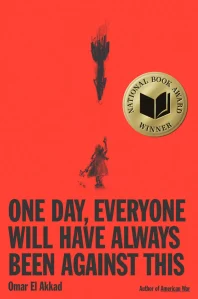
 In January of 2025, about a month before One Day, Everyone Will Have Always Been Against This was set to be published in North America, I received an email from my editor. He said he was worried: we’d gotten no confirmed major media at that point. By this he meant national radio, morning TV, that sort of thing. Usually, such coverage is arranged ahead of time, and because it tends to move books off shelves pretty reliably, some of the bigger publishing houses spend a lot of their time trying to get it. He asked me, given that I’d spent a decade in journalism before I published my first novel, if I had any connections in that world. I didn’t.
Very few people get into this line of work unless they believe in the power of language to dream up a better world, but publishing is still an industry. Commercial concerns never go away. Most books get no major media attention. Hell, a lot of books – far better ones than anything I’ve ever written – get no attention of any kind. As with all the coverage One Day would receive over the next year, none of it was guaranteed.
There had been a kind of tension around everything to do with this book’s publication, dating back to early 2024, when I travelled to New York City for the first formal pitch meeting with the senior editors at Knopf. It’s a book about genocide, written in the early days of that genocide, at a time when even using the word “genocide” was enough to get people fired from their jobs. It’s a book about what it means to live amidst the crumbling façade of mainstream Western liberalism, written by an Arab Muslim. None of this stuff matters, in the grand scheme of things, but it meant that when my editor sent that email just before publication, I felt the same tension, the sense that putting this book out into the world – again, by the relatively inconsequential standards of commercial publishing – was not going to be straightforward. It needed to do well.
And it has done well. It’s received some positive reviews and award recognition and for a while after publication it flirted with the bestseller list. I don’t think this is a function of the work’s quality, so much as the fact that a lot of people, for more than two years now, have felt like they’re losing their minds – waking up every day to see some of the most grotesque state atrocities imaginable: the mangled bodies of Palestinians torn to shreds by bombs our tax dollars pay for; the brutalization of those who protest this carnage. For at least some of those folks, this book – any book that at least addresses this crazymaking state – has been like a steam vent of sorts.
Bookstores can get support from the American Booksellers for Free Expression
One Day’s traction didn’t end up being the result of major media attention (though some of that came later, as the nature of the slaughter became less and less deniable; as most everything I have to say started to sound more and more tame, more acceptable to state). It was instead the result of indie booksellers deciding they wanted to support this book. This had been the case before, with both of my novels. Were it not for that kindness of a place on the Staff Picks table or a copy set cover-out on the shelf or a positive review on some industry forum, I’d have no career at all. This time around, though, there was a sharper edge to things. On one book tour stop, in Canada, the bookstore set to host me received a legal notice, an ultimately hollow threat to seek a cease-and-desist order if they did the event. They did the event anyway. At a bookstore in Massachusetts, one of the managers showed me the deluge of hateful messages they’d been getting: allegations they were hosting a terrorism supporter, the sort of stuff it has always been easy to say with impunity in this country about a guy named Omar. I apologized to the manager for the trouble I’d caused her; she waved me off. It wasn’t about me, or this book – it was about the simple fact that backing down in the face of such threats, such obvious disdain for the basic principle of free expression, risked rendering the whole enterprise of bookselling intellectually and ethically impotent.
We’re in a dark place. Every day, some new institution – a major corporation, university, cultural organization – caves to fascism’s demands. Irrespective of whatever it is my book has or hasn’t done, I’m grateful to the folks who don’t cave.

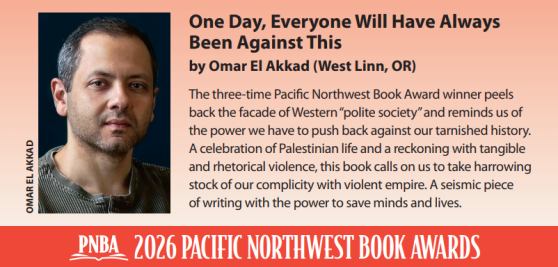
Honor Omar El Akkad at his award presentation party on February 10, 2026 at 6:00 pm at Broadway Books in Portland, OR. This is his third Pacific Northwest Book Award; his first was in 2018 for American War and his second was in 2022 for What Strange Paradise.
NWbooklovers posts original essays from this year’s award winners as featured posts. You can enjoy essays from past winners of the PNBA Book Award in our archive.