I grew up in a house where creativity lived in the walls. Cartoons taped along cabinets, carved rocks on display, a small unicorn painting near the coffee cups, and a 4-foot plaster cast of illustrated ducks hung on our dining room wall. As a child, I didn’t realize how these surroundings shaped my memories. They were simply “home.”
My dad, Shigeru Goto, known to everyone as Sam, left a trail of whimsical and imperfect creations everywhere he went. My mom, Dee, collected stories from our family and community around the Pacific Northwest. Together they maintained a thread through the physical and oral history of our family and the Japanese community surrounding us.
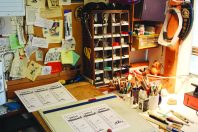
Sam Goto’s work area
On the day after Thanksgiving 2017, my dad went into the hospital. He passed away three weeks later. We kept his basement workspace exactly as he left it—pens in jars, glasses on the desk, and a stack of Seattle Tomodachi cartoons ready to go to print. It was a room suspended in time. He inked his last cartoon while tethered to an oxygen tank at the kitchen table, bringing in the New Year. It was published in The North American Post alongside an announcement of his passing in January 2018.
Shortly after, a longtime reader wrote a letter to the paper expressing his sorrow. He said, “If you ever have a book of Sam’s cartoons, I would surely buy one. I am only sorry I am not able to get a signed copy.” During my dad’s memorial, the idea of the book was born.
In early 2020, I returned to Seattle after almost thirty-five years away, just in time for containment. I started to cull and organize my dad’s belongings. I saw everything with new eyes: journals, piles of sketches, boxes of photos, and sticky notes with his simple ‘isms: Tell the truth. Keep going. It’s better to get things done than to be perfect.
What I had once thought of as clutter became a map of who my dad was and formed the basis for what the book would become.
In the fall, a year after the book’s release, I decided to finally replace the worn basement carpet. I thought I could work around my dad’s workspace, preserving the essence of his creativity. But everything was interconnected. The cabinetry, shelving, bulletin board, and desk were built as a single, unified structure; once one piece came down, the rest followed. I called my mom downstairs just before the last section fell.
Watching it collapse felt like losing him all over again.
Through this process, I began to see the book differently. It was never just a preservation project. It became a way of connecting to my dad’s philosophy and story, striving to live the American dream while struggling to maintain his culture and samurai values. Stories of hardship and resilience that were recognizable as immigrant, not just Japanese, stories carried forward into the next generation.
There is an irony in Japanese culture: to honor your heritage, one must remain humble, yet as an artist, your work is meant to be seen and shared. My dad lived in that grey area. He was modest and put his work forward quietly, not craving recognition.

Sam Goto’s owl sculpture
When I was in junior high, he brought a carving to our local community center for a sculpture competition: an owl carefully etched from a hillside rock. I remember his disappointment when he picked it up early. It hadn’t made the finals.
My dad didn’t create art to win awards. He drew, carved, tinkered, and modified things because that was how his mind worked. It was how he saw the world, and how he shared it.
To the Pacific Northwest Booksellers Association and its independent booksellers: 心より感謝いたします — kokoro yori kansha itashimasu. From my heart, I am grateful. You hand-sell books that might otherwise disappear. This recognition gives my parents’ story a chance to reach people who never knew them.
To my parents: お世話になりました — osewa ni narimashita. Thank you for everything you’ve done for me—a phrase for care given quietly over a lifetime, with no way to repay it.
My dad never thought of himself as a “real artist.” His work reflected wabi-sabi, finding beauty in imperfection and the marks left by time. It was quick, personal, and authentic—carrying humor, values, and memory in simple drawings. Alongside my mom’s ongoing collection of stories, their work documents a Japanese American experience shaped by humility, resilience, and the natural rhythms of Pacific Northwest life.
He didn’t live to see it, but he is seen now.
ありがとうございました — arigatō gozaimashita.
Thank you.
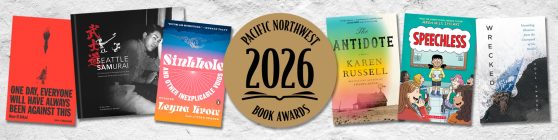
Celebrate with Kelly Goto at her award presentation party on February 27, 2026 at 7:00 pm at Third Place Books – Ravenna in Seattle, WA.
NWbooklovers posts original essays from this year’s award winners as featured posts. You can enjoy essays from past winners of the PNBA Book Award in our archive.