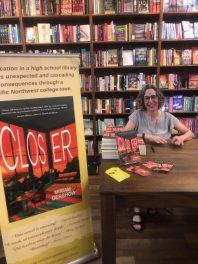
Eugene, OR author Miriam Gershow signing at Paulina Springs Books in Sisters, OR during the PNBA Spring Pop-Up 2025.
From LitHub:
Miriam Gershow Recommends Zoe Heller, Emily St. James, Jim Shepherd and More
I am a writer living comfortably in middle age, embracing every gray hair, shopping the Eileen Fisher racks with glee, and yet I’m obsessed with high school. My new novel, Closer, takes place in and around a public high school in fictional Horace, Oregon when two white students taunt a Black student in the student library. Unexpected consequences ripple out into the community, affecting students, faculty and parents. My first novel, The Local News, also took place in high school, following a teenaged Lydia Pasternak in the year after her older brother disappeared. And the opening two stories of my collection, Survival Tips, are set in high school, the first about a teenager whose best friend’s father runs off with one of his community college students, the second a new teacher who faces a particularly daunting parent conference.
The crowded, sweaty hallways of our youth, as I see it, do not belong only to YA books. I’m old enough to have a kid finishing his freshman year, and I’ve come to embrace the part of me that remains preoccupied—creatively and psychically—with high school. The person I was then—awkward, gangly, too loud by half, desperate to be something—feels like a shadow self, still there at my core, even if papered over by thirty plus years of of striving, heartbreak, mortgages, successes, medications, homes, therapists, missteps, community, and family.
Judging from the small army of writers who write about high school for adult readers—Tom Perrotta’s Election and Curtis Sittenfeld’s Prep among the most successful—I am not alone. Combine teenagers’ natural lability with the naked social stratification of high school, and you end up with novels rife with complex, layered storytelling. Few settings force together so many characters with so many competing needs in such close proximity for so long; nursing homes come to mind, prisons too. Here are a half dozen books worth the trip back into the classrooms and corridors of high school.
*
Zoe Heller, What Was She Thinking? [Notes on a Scandal]
Heller writes one of my favorite genres of high school novel: adults behaving badly. In What Was She Thinking? longtime teacher Barbara Covett tells the story of the new art teacher, Sheba Hart, and Hart’s secret affair with a student. But this is not a lascivious book. We only see Hart’s affair through Covett’s eyes, and what a slyly voracious narrator Covett turns out to be. What begins as a story of Hart’s bad deeds soon turns into a wholly different tale of loneliness, envy, and the way we make other people’s stories our own.
If you saw the movie with Judi Dench and Cate Blanchett, don’t be fooled into thinking you know this book. Heller’s gift is in creating an utterly believable narrator who inhabits the acerbic periphery until she becomes the story, Covett, true to her name, is an unraveling knot of loneliness, envy, and need.
Emily St. James, Woodworking
In St. James’ debut novel, Erica Skyberg, a closeted trans high school teacher in small town South Dakota, is doing her very best not to behave badly. Her worst offense is consistently testing the patience of her closest confidant, 17-year-old Abigail Hawkes, the “Only Trans Girl” at Mitchell High. Early on, Abigail insists, “Erica’s not my friend, but she’s not just my teammate either. She’s some secret other thing. Maybe I have to figure out what that is.” Woodworking is about many things—transness, family, bigotry, politics, the world on the cusp of Trump 1.0—but at its core Woodworking is about “figur[ing] out” of the relationship between Abigail and Erica. There are role reversals aplenty—Erica is the naïve adolescent in her transness, Abigail the more experienced cynic. But there is also a very real sweetness at the center of the unfurling friendship as each helps shepherd the other through coming of age in an often forbidding environment.
Jim Shepherd, Project X
I read Project X when it first came out in 2005, before I met my now-husband and before my son was even an idea, which is why I was able to wolf down the story of Edwin Hanratty—loser, misfit, nobody—without question. Shepherd so believably embodies the voice of a child who is unseen by his teachers and his well-meaning but oblivious parents, and who is acknowledged by his peers only long to be tormented by them. Shepherd’s gift is allowing the reader to see what everyone else is missing, Edwin’s everyday frustrations, confusions, and alienation. You’d have to be a monster not to love Edwin at least a little, even as he and his only friend, Flake, plan sickening—and by now, sickeningly familiar—violence onto their school.
I suspect that today, I’d be hiding behind my fingers as I forced myself to turn the pages. But Project X should be required reading for parents of teens and teens themselves, because of its uncommon empathy, its alarm bells all the way through, and a final image as terrible as it is searing. Twenty years later, I still see it.
***
Don’t miss the rest of this fabulous reading list from Eugene author Miriam Gershow, whose new novel Closer published this month and whose collection Survival Tips was a recent finalist for the Oregon Book Awards.


