In the early 2000s, Laura Stanfill (Forest Avenue Press) and Nancy Townsley (author of the new debut novel Sunshine Girl) were colleagues at a community newspaper chain in Portland, Oregon. Nancy’s new novel follows Eliza Donovan, the daughter of a journalist, as she pursues her own reporting career amid turbulent industry changes and, in the process, uncovers a family secret.
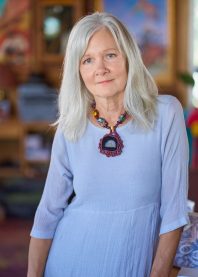
Nancy Townsley, author of “Sunshine Girl”
Nancy graciously agreed to answer a few questions in this exclusive interview for nwbooklovers.org.
Laura: You are an award-winning journalist with decades of experience on the beat as a reporter and editor. When and why did you start exploring fiction?
Nancy: It was honestly kind of a knee-jerk reaction to deciding, in a matter of months, to retire from newspaper journalism after 38 years. It was 2017, around the time Trump took office the first time, and journalists were being called “fake news” and “enemies of the people” (and worse). I knew it was time for me to go, because I wasn’t having fun anymore and I felt my work would suffer if I stayed. By that spring I was playing around with an early concept for Sunshine Girl, starting to string sentences and paragraphs and chapters together. At that point I wasn’t entirely sure whether it would be nonfiction or fiction. But the more I thought about it, the more I became intrigued with writing a novel. I wanted to play on the page more than I’d been able to in the past, as a reporter and editor.

Laura Stanfill, author of “Imagine a Door” and publisher at Forest Avenue Press
Laura: Sunshine Girl is a coming-of-age story that weaves through political moments, as your protagonist Eliza carves out a career for herself in the newsroom. What motivated you to start writing fiction and what motivates Eliza?
Nancy: I turned 60 the year I left newspapers. I wanted to give myself a new challenge, and writing fiction—something I had never done in my time in the newsroom, when just-the-facts was the job—sounded really good to me. It was also a time when I felt a new kind of empowerment brewing inside me: I could write a book! With strong female characters! About journalism! And so that was what I set about doing. Eliza is the embodiment of what—looking back—I would have wanted for my career had I known back then what I knew by 2017: Agency, forthrightness, confidence, sticking up for what I knew was right. With my sources and in my newsrooms. Eliza is fiery and bold and determined, ready to take on a changing news landscape. She is me as my best, most genuine grown-up self.
Laura: A debut novel is a very different byline experience than a newspaper article. In community newspaper-land, there’s always another deadline to meet, but with fiction, the gestation can be long and slow, and the querying process to find an agent or publisher takes the time it takes. Then there are edits and revisions! How are you feeling now, as Sunshine Girl makes its way into the world?
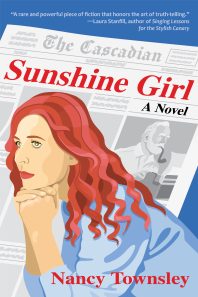
“Sunshine Girl” officially publishes April 22, 2025
Nancy: Oh, it really is! I like to tell people that in newspapers, stories are character-limited. Maybe a news editor only wants 10 inches or even 25 inches, but reporters get used to sticking to an inch count and meeting or beating deadlines. They finish one story, it goes out in the next edition, and they’re on to the next one. Bingo, bango, bongo. In fiction it’s completely different. When I started Sunshine Girl I had no idea how that time trajectory would go, and I think I approached it, in the beginning, like a news story: Write, finish, move on. But that didn’t do the trick at all! Instead, it has taken eight years from those first tentative sentences to pub day, April 22! I only submitted to indie presses, and surprisingly, my novel—set in several locales on the West Coast—was picked up by Heliotrope Books, a small publishing house in New York. After I signed the contract I spent the next 18 months in revision-land. My publisher Naomi has been wonderfully patient and supportive. Now that the book is almost here, it feels like a baby is about to be born. The gestation was long and arduous. Labor was intense. All my nerves are on high alert. But soon, release and relief!

“Imagine a Door” is available now from your favorite indie bookstores
Laura: Your character Martin is lovable and flawed—as all great fiction characters must be, to come alive on the page—but he’s also written in memory of a very special news editor. Can you talk about the real person who inspired the Martin character, and about his influence on you?
Nancy: I love this question, Laura. Thank you for the opportunity to talk about Michael. He was the news editor at the ma-and-pa-owned rural weekly paper where I took my first job in journalism. He lobbied our publisher to hire me for the sports editor position, which was hilarious, since my only bona fides in that regard were being a high school cheerleader and having watched a bunch of Beavers football games in college at OSU! Yes, my character Martin was certainly inspired by Michael, who passed away from cancer in his 30s. His influence on me was tremendous. He taught me to always be curious, to stick to the facts, to write honestly but also compassionately, and to keep my eyes and ears open to interesting and important stories.
Laura: When did you start your community newspaper career? Looking back on how the industry has changed, do you have one period or era where you felt especially supported or empowered to fulfill the mission of reflecting a community back to itself? And is there a time period where that started changing?
Nancy: I started my career in 1980, when computers weren’t yet online and we typed our stories up on old IBM Selectrics. We also did “paste-up” using this weird waxy glue and X-ACTO knives! Pretty medieval compared to today’s digitized world. My debut is written in three sections: Heyday, Payday, and Mayday. I guess I’d say I felt most supported and empowered in my profession during the late Heyday/early Payday period (don’t be fooled into thinking I made loads of money, though, because I didn’t!). I was reporting on city council, parks board, schools, and sports, and I even got to write features about illegal gambling and a crazy outdoor hippie concert in rural Yamhill County! That was during the mid-1980s and early 1990s, before the internet changed literally everything, including a dictate to post our stories online before the print paper came out each week.
Laura: What does your writing process look like? I used to aim for a steady routine, because that’s what I heard writers were supposed to do, but I ended up getting frustrated when my parenting and publishing duties got in the way of establishing a regular process. So I want to start asking this question of more people, not so aspiring writers find out how to do it, but to normalize the idea that any process that works for you is great.
Nancy: I get what you’re saying about responsibilities and distractions eating away at time with the page. My writing “practice” is all over the map! I get up very early, at 4 or 5 a.m., sit downstairs with my dog and write. Nowadays in particular, it’s tough not to get sucked into the news. And since I’ll always be a newshound, it’s hard to look away. I try to skim the headlines—not too deep a dive—and then focus on the next section of whatever I’m working on. Fridays are a day off, because that’s when I take care of two of my little grandchildren, ages 3 and 5. Sometimes they inadvertently provide me with writing prompts, though! Most weeks I probably get eight to 10 hours of pure writing in. I’m almost 40,000 words in on my second novel, a story about a guy who starts a commune for indigent elderly people who can’t afford healthcare. I’m having loads of fun with that, setting my mind and heart free.
Laura: Thank you so much, Nancy! Congrats on your novel.

Laura and Nancy together in 2015
Nancy Townsley lives in a floating home along the Multnomah Channel near Portland, Oregon. Her debut novel, Sunshine Girl, was inspired by her long career as a newspaper journalist. She continues to have a keen interest in the cultural and political changes altering the media landscape, channeling that fascination into writing fiction and nonfiction. Her work has appeared in Newsweek, Hippocampus, The Big Smoke, Nailed magazine, the Timberline Review, Elephant Journal, Mountain Bluebird Magazine, and several anthologies. “Leaving Tulum,” an excerpt from her first book, can be found at unleashcreatives.com.
Laura Stanfill is the publisher of Forest Avenue Press and the author of Imagine a Door, a book for writers.
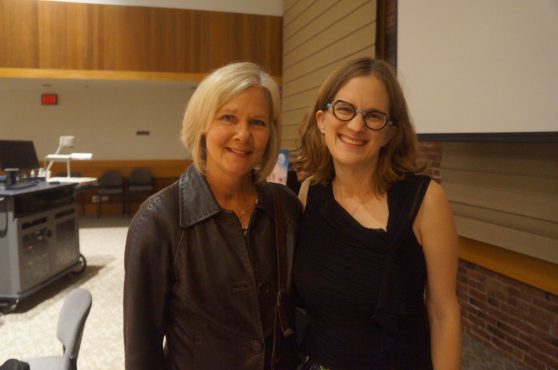
Nancy and Laura in 2018