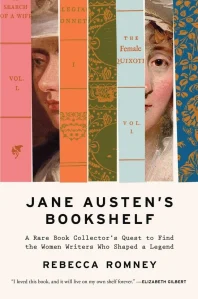
 Romney, as the subtitle notes, is a rare book collector, and one of the things such folk do is ask pointed questions and do follow-up research. In Romney’s case, it was a line written in a non-fiction book about the history of the novel, which stated that the formative period of Jane Austen’s life was “was one of the most fertile, diverse, and adventurous periods of novel-writing in English history.” And yet, when one checks the “canon,” we leap from Laurence Sterne’s Tristram Shandy (1767) to Austen’s Sense and Sensibility (1811). Romney’s reaction was: Wait, if that period was so great, why aren’t we still reading those writers?
And then, like a good book collector, she did some follow-up research. The result is, wait for it, Jane Austen’s Bookshelf. Romney highlights and explores the careers and outputs of Frances Burney, Ann Radcliffe, Charlotte Lennox, Hannah More, Charlotte Smith, Elizabeth Inchbald, Hester Lynch Thrale Piozzi, and Maria Edgeworth: eight fabulous women writers who, frankly, provided Austen with the literary education that hugely influenced Austen’s own output.
–A Good Book, Sumner, WA
Women’s History Month is a great time to focus on women authors. You can recommendations at A Good Book and other independent bookstores.


