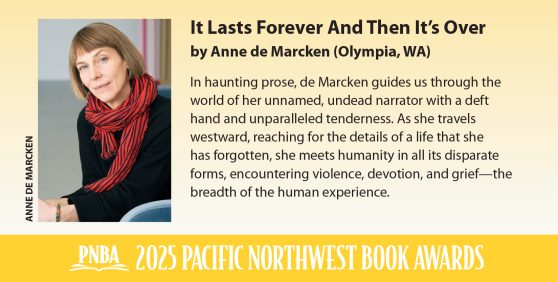
 An old woman was standing in the kitchen doorway and I couldn’t figure out how to write her across the room to the sink. It was a kitchen I knew well. A sink I had stood at many times. A short distance with an impossible number of details in my way. How to account for the smell of coal dust and kerosene, the light from the two north-facing windows, the jumble of tea boxes on the sideboard, the tick of the clock above the sink?
Suddenly is a word I avoid using, but I’ll use it here. Suddenly I realized I didn’t have to—maybe shouldn’t—try to fill in every corner and surface. That all of the details so important to me in life were not only obstacles to my writing, they would be obstacles to the reader. It isn’t that the details didn’t matter—the smell, the light, the mess, the order. It’s that everything matters. Everything inside the story and outside the story. Everything. What I mean to say is that I realized the kitchen in my mind was no more important than every other kitchen already in each reader’s mind. Every reader brings their own kitchen.
When you need to find a spoon in someone else’s kitchen, you go first to the drawer most like the one where you keep your spoons. Finding instead tin foil and baggies, you furtively move on to the next-most-likely drawer…and the next, abandoning your own sense of order and with an increasing sense of trespass.
I’ve told this story before. Always it has been about learning to leave space for the reader to imagine their own familiar scene so they can find their spoons—which is to say, themselves. The reader becomes a collaborator in the telling of the story. But I am writing this now—trying to write this—because my book has been lucky enough to win recognition in the place where to many of its readers—to you, perhaps—the details are as familiar as they are to me. We share the same kitchen.
Special is another word I avoid using. And I can’t quite bring myself to use it here. But how else to describe this situation? Toni Cade Bambara writes about the idea of an “authenticating audience”—the people who can confirm the truth of your work because they have lived it, felt it, themselves. That’s you.
It Lasts Forever and Then It’s Over is from here, the Pacific Northwest—a Pacific Northwest…the one that I know. This is where it was written and where it is set. It is very possible you bring the same empty beach to the book as I do. The same blackberry vines. The same roadside espresso stands. Maybe you, too, have swum in the Salish Sea, driven the same stretches of I5, Highway 8, Highway 101…back and forth over the same ground the protagonist covers.
In Place: A Short Introduction, Tim Cresswell writes, “…place is not just a thing in the world, but a way of understanding the world.” Places, he says, are “spaces which people have made meaningful.” My book is about how we’re made up of our relationships—to things, to people, to places—and about how we lose ourselves when we lose those relationships. As I wrote it, I needed to feel connected so that I could feel the terrible loss of connection. I needed to keep my heart soft. In a book so much to do with rage and grief, softness is everything. It is so easy to harden yourself against loss. The specific details of this place—the low sky, the jellyfish, the clearcuts—tethered me to a particular tenderness I have even for what I find unbearable, and a sense of what it would mean to live without it. I couldn’t have written this book without this place.
I wonder, though, where amid the familiar details is the space left open for you?
There is a crow in my book. In Olympia, there are many crows. In every city I visited on my book tour, I saw crows. At nearly every reading, someone asked me what the crow symbolizes. I am a stickler on this point: nothing. The crow is a crow. It does not mean what I want it to mean or what you want it to mean. It is exactly and only itself. Unlike a kitchen, a crow is both familiar and unknowable. Maybe the crow is the open space. Every reader has a crow.
In the book, the protagonist carves out a space for the crow in her body. It makes no sense. It can’t happen in real life. An impossible gesture to contain an impossible truth—that we are all connected and we are all alone. That we need each other and fail each other. Maybe that is the open space—the one you carve in your own chest to make room for the familiar unknowable, for hope and devastation.
And then there is you, “that indefinite, promiscuous, expansive pronoun,” Judith Butler calls it. The whole book is addressed to “you.” A particular you. But also you. You is you, reader. And you is also the person who is “you” to you, the person, real or imagined, to whom you address yourself, the person you travel toward. You is the quavering intimacy on which we depend. “Without you,” Butler writes, “we are wrecked and we fall.” You is the open space where we meet.
Watch this site for information about the Pacific Northwest Book Award winner events hosted by independent bookstores around the region.
NWbooklovers posts original essays from this year’s award winners as featured posts in January and February. You can enjoy essays from past winners of the PNBA Book Award in our archive.


