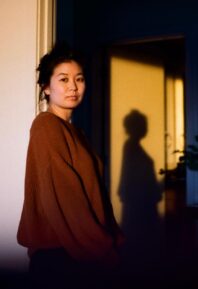
Elaine U. Cho
(photo: Sam Plott)
From Monday February 5, 2024: Maximum Shelf: Ocean’s Godori
Elaine U. Cho‘s debut novel, Ocean’s Godori (Hillman Grad Books/Zando, April 23, 2024), is a rollicking space adventure featuring a brave new world in which a united Korea leads the solar system, but unrest is never far away. When ace pilot Ocean Yoon’s best friend’s life implodes, she’s the only one who might be able to save him. Cho has an MFA in flute performance from CalArts and has worked for several arts nonprofits, including ArtsWest and Seattle Music Partners. She’s also a film critic for Mediaversity; a former bookseller at Elliott Bay Book Company; and recently became associate editor at Shelf Awareness. Cho lives in Seattle, Wash.
Ocean’s Godori is one of three inaugural titles acquired by the partnership between media powerhouse Lena Waithe’s Hillman Grad Books and indie publisher Zando. That’s impressive recognition… and maybe a potential step toward your book transforming to the screen? Your novel is so cinematic; did you envision this as a film?
 I love film so much! And there are definitely a lot of film influences, as well as many scenes that I envisioned in my head playing out like a movie before I wrote it out. When I was writing, though, I really wasn’t thinking of it ever becoming a movie. Part of that is because so much of it is interior–there’s a lot going on within the characters’ heads and motivations, and I wasn’t sure how that would translate to screen. Also, I couldn’t even think past the idea of this being picked up as a book! My agent and I nearly keeled over when we heard that Lena and her team had read and enjoyed it!
Korean history and culture are deeply ingrained in your writing. Were you born in Korea? Did you have a Korean/Korean American community growing up? How much Korean do you speak?
I was born in Portland, Oregon, but I’ve been all around–New York, Ohio, Texas, California, Oregon, and now Washington! So, you can really call me “all-American.” That said, my family and I spoke solely Korean until I went to kindergarten, and the teachers were a bit appalled. From then on, I learned English fairly quickly and left Korean in the dust. I’ve gone back and visited Korea a few times, and this past year I went for the first time in 12 years! It felt very emotional.
I wouldn’t say that I grew up very Korean or had a strong Korean community other than the friends my parents had. I think for our generation growing up, it was a little more ingrained to “fit in” and being Korean wasn’t a part of that. It wasn’t until I was a lot older that I found myself wanting to find out more, learn more, really take pride in who I am as a Korean and how I fit in the world. At first, it almost felt like… was it too late? Did I already miss the boat on being “Korean”?
Clearly not, because the Hallyu wave shows little sign of abating. Any thoughts on the popularity of all things Korean?
A few things come to mind! Definitely ease of access helps. When we were younger, if we wanted to see the latest K-drama, we had to go borrow VHS tapes from the local grocery store. Or maybe you’d be able to nab a K-pop CD if you were lucky enough to live in Flushing, N.Y., or Los Angeles. But now with K-dramas on Netflix, music videos on YouTube, Korean books getting translated, it’s really opened a floodgate in terms of what people can read and watch. Translation is a huge part of that, too! Like Bong Joon-ho [Korean director of the Oscar-winning Parasite] says, “Once you overcome the 1-inch-tall barrier of subtitles, you will be introduced to so many more amazing films.”
 How did you choose sci-fi as your debut genre?
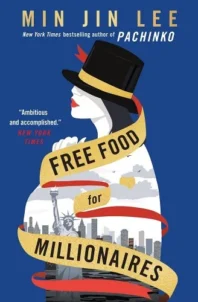
Sci-fi felt like a natural fit for Ocean’s. The genre is a marvelous balance of contrast–using a future setting to examine present concerns or traveling further into deep space to learn what really makes us human. I wanted to write in a genre I love, which is why Ocean’s has elements like a found family of misfits in space, and hoverbike chases. But the heart of the story is about a group of people navigating their messy 20s and figuring out where they fit in. [Min Jin Lee’s] Free Food for Millionaires was as much an influence as [Philip K. Dick’s] Do Androids Dream of Electric Sheep. While I was searching for translated Korean sci-fi and Korean American sci-fi, I thought… well, why not write what I want to read?
Please enjoy the full Shelf Awareness interview here. Find Ocean’s Godori at your local, independent bookstore or online with Bookshop.org.


