 Perhaps I shouldn’t admit this. But every time I write a book, it’s only at the very end that I find out what it was actually about. Somehow, I’m surprised every single time this happens.
I write middle-grade narrative nonfiction, which may seem like it’s straightforward. My books all stem from questions I have or topics I’m curious about. Shouldn’t that make finding the theme of the book entirely transparent?
In writing my first book, Race to the Bottom of the Earth: Surviving Antarctica,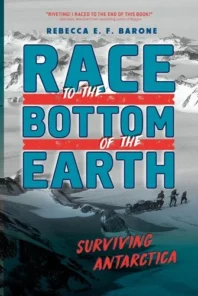 I was motivated to answer questions about the coldest place on Earth. How do people survive there? Who were the first people to reach the South Pole? What does it look like to live in Antarctica today? That’s a pretty direct story, right? I thought so, too… So it came as a complete surprise to me when I handed in a book to my editor that actually examined the question: “what does it mean to be a hero?”
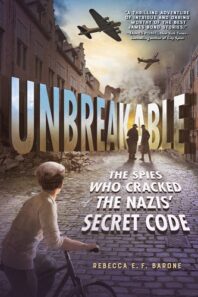 For my second book, Unbreakable: The Spies Who Cracked the Nazis’ Secret Code, I wanted to write about real-life spies. Spies are cool (obviously). But what do actual spies, not the James Bond kind, look like and do? I figured I’d write about invisible ink, miniature cameras, and all kinds of fun deception. And I did write about all that. But it turns out that the spy business is so much more… You could have knocked me over with a feather when I realized I’d written a book about teamwork and perseverance under the worst kind of oppression.
This third time around? Well, I knew I wanted to write Mountain of Fire: The Eruption and Survivors of Mount St. Helens to learn more about volcanoes. I knew I wanted to tell about the heroes who were scientists and survivors. But you better believe I was bracing myself for what the story would actually become. And this time, I had some hints along the way.
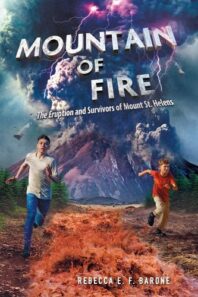 One of the coolest things about writing Mountain of Fire is that many of the people who experienced it are still alive and happy to talk about their experiences. I loved hearing directly from the people who were there when the mountain erupted. Their perspective shaped this book more than anything else.
Volcanology, or the study of volcanoes, was a fairly new science in the 1980s. As Mount St. Helens began to shake and blow off steam, scientists rushed to the scene. Unfortunately, they were learning on the job. Mount St. Helens was unlike any volcano they had seen before.
People I spoke with told me how the mountain was giving them mixed signals. First it would look like an eruption was imminent. Then the next day it would look like it was calming down. Hour by hour, it sometimes seemed, the mountain would change. They didn’t know what these signals meant. They were learning new information and developing new scientific techniques with each passing day.
1980 already seems so long ago. It’s easy to dismiss what we think of as “old.” I was content to let their memories be memories and go about my way, assuring myself that these days we know a lot more.
Until they told me I was wrong.
In interview after interview, scientists began telling me how much the eruption of Mount St. Helens reminded them of the pandemic.
Just as they were learning on the fly with Mount St. Helens, scientists spent 2020 learning as they went. This time, it was a virus instead of a volcano, but the problem was the same. How do you lead and guide people while learning at the same time?
In both cases, people were clamoring for information. They were begging to know what to do to stay safe. And in both cases, the process of science – the backtracking and revision that is necessary in any process of learning – wasn’t as straightforward as anyone would like it to be. In the end, science reaches the truth. The process of getting there, however, is often messy.
Not everyone is called to be a scientist, but we’re all living in a world that is constantly changing and not always nice. We all have to live with the idea that danger is out there. From a volcano or from a virus, we need to learn how to deal with dangers as they arise.
I didn’t set out to write a book that pleads for the necessity of science literacy. I set out to write an adventure story about volcanoes.
In the end, what this book really says is that it is our job – yours and mine, whether we’re scientists or not – to be good stewards of information. This lesson is all the more important in the face of this era of “fake news” and conspiracy theories. It’s only by learning to read critically and understand that science evolves – and to believe in that process of getting to the truth – that we’ll stay safe.
The ideas for my books all arise out of questions I want to know more about, but every single one of them have taken me to places I didn’t expect. I hope my readers enjoy the adventure in Mountain of Fire. I hope the story reads like an edge-of-your-seat survival thriller. But, even more so, I hope this book helps readers to understand that science is an evolving process, and that every single person has a duty to become science aware.
Rebecca E.F. Barone is an engineer and author. She has worked on technical projects as diverse as injury analysis for the NFL and engine calibration for hybrid cars. Realizing her love of books in addition to numbers, she now describes the world with words rather than equations. Her first two books, Race to the Bottom of the Earth: Surviving Antarctica and Unbreakable: The Spies Who Cracked the Nazis’ Secret Code, received a combined nine starred reviews and were featured on numerous “Best of” lists. Visit her website at www.rebeccaefbarone.com.


