Jamil Zaidi and Rebeca Lee Morales
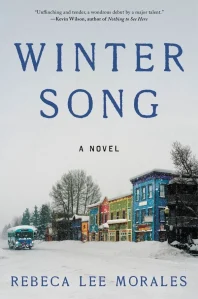
From debut Eugene, OR author Rebeca Lee Morales, Winter Song is a moving, pitch-perfect novel of love, community, and the redress of past wrongs in working-class America, for fans of Elizabeth Strout and Kent Haruf. In the frozen Minnesota hinterland of 1986, police chief Gordon Trent, facing mandatory retirement, squares off with Byron Lugo, a young man just released from prison for a vehicular homicide he insists he didn’t commit, and Byron’s fight to clear his name forces the chief to reckon with his own judgment, loyalty, and legacy.
 Jamil: You’ve said that the first spark of this novel came to you when accompanying your father to pick up your brother on his release from prison. What was it about that moment that sparked a story?
Rebeca: The moment was emotionally charged and bittersweet. You see someone you love released from what has obviously been an ordeal you can’t even begin to imagine, not really, and your heart breaks. You realize that there’s no way to restore what’s been lost. Time has gone by and life along with it, and there’s no way to go back. It makes an impression that stays with you long after the moment has passed. Winter Song is not a direct exploration of that episode in its entirety, but I did reference that moment, that bittersweet sense, in several scenes in the novel.
J: Your brother was released in 1990. Why did you go slightly further back to set the story in 1986?
R: That’s an interesting question because I never really considered the timeline. If memory serves, I arrived in Montevideo, Minnesota in the fall of 1983. I was twenty-one and the leaves were turning. By 1986 I had settled in and had a job, a car, and a place of my own. Two of my younger sisters had come to live with me. So, 1986 is about the time I began to consider Monte home. I still think of Minnesota as home—as well as Holland, Michigan, where I was raised. I imagine that the sense of ease and familiarity I felt in Monte by 1986 had something to do with choosing that year, and perhaps the weather. Winters were rather harsh back then.

photo by Emily Chaison
J: You’ve spoken about being inspired to be a writer when, at a young age, you read a copy of The Sound and the Fury that you borrowed from your older sister. Since the first spark of inspiration for this novel came decades ago, did you write any versions of this story previously? Or did the idea percolate for decades before you wrote it?
R: Yes, it’s a bit embarrassing that I read… Through the fence, between the curling flower spaces, I could see them hitting. They were coming toward where the flag was and I went along the fence. Luster was hunting in the grass by the flower tree. They took the flag out, and they were hitting… and so forth, and I thought, I can do that! But then I was only twelve or so. In a way, I didn’t even know what I was reading. I mean, I had no idea that Benjy was a nonverbal narrator. But I did know that the writing was stunning. It seems it’s become fashionable to disparage Faulkner in certain quarters, but I stand by him. I stand by him all the way. As to the second part of the question, I didn’t try to write about the experience with my brother for many years. In a way I still haven’t. For a long time I wrote short stories, not especially good ones. It was Robert Morgan who first suggested that I write a novel. So, I did. Though it took a while.
Read the full interview here.
This book is featured in the PNBA Give Books Holiday Catalog, available at many bookstores. Winter Song hits the shelves December 1, 2026, but you can preorder with your favorite bookstore.