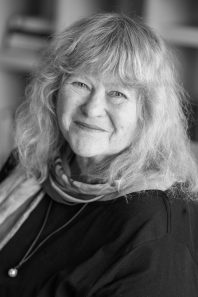
Rebecca Knuth; photo by Sari Singerman
Maybe I was meant to live and write in Portland, Oregon. But first I had to get London out of my system.
In 2014, I retired from the University of Hawaii and moved to London. I’ve lived in the city before, short-term, but this time, I settle in for two years. My agenda: to reinvent myself as a writer of creative nonfiction and break from academia’s rigid expectations. The stakes—a fulfilled present and future—were high.
On the first day, over tea, I give myself the first of many pep talks about making the most of my time here, reminding myself that I was, in part, scoping England out as a permanent home. While taking writing classes and immersing myself in the literary scene, I’ll participate in community life and preempt an American upbringing with a conscious pursuit of Englishness. Could I transform intense Anglophilia into a life in this country?
Two weeks later, selling raffle tickets at De Beauvoir Park’s annual community event, I solicit sales for three hours, circling past the Women’s Institute table timidly—their energy is fierce and sales on baked goods brisk. I pass a fire engine on display, the face-painting stand, and the dog show. I am in camouflage, a spy or ethnographer in search of Englishness and belonging. On most quests you leave home and return there, though changed. Perhaps my quest in London was, in part, an attempt to search for something that felt like home or try to create it. Would it change me?
 Taking classes, volunteering, guiding, and joining clubs takes me into homes and gives me an insider’s view of Highgate Cemetery, the London Library, and hallowed institutions. I am taken back in time. But there are clues of another calling. Once, after boarding an old double-decker party bus, a replacement option for a shut-down transport connection, the driver turned on the loudspeakers, and as I looked out into the emerging twilight, down into people’s backlit living rooms, the American twang of Willie Nelson’s “You Were Always on My Mind” slipped through a barricade I was largely unaware existed. Over the years, I had placed a moratorium on feelings—emotions were all right in their way, but slowed you down. That night, Nelson’s voice melted something inside and then, startlingly, called me home. But home was London now—wasn’t it?
My turning point came when I was visiting my son and mother back in the States and became sick. In the emergency room, I was tested, found negative for strep, and discharged. The next day, at a nearby urgent care facility, the staff said that my throat was dangerously swollen, my blood pressure too high, my fever 103-degrees, and they feared for my airways. Diagnosis: strep. Result: an ambulance to the hospital. Released after two days, I return to be operated on for an abscess and hospitalized again. Sick of forcing myself to do and be, and on doctor’s orders, I stand down for a while and delay my return. After reentering through Heathrow, I catch the Underground to King’s Cross station and a taxi home, where I sleep for twenty-four hours. Then, back in the saddle. But I had slowed down enough to get in touch with my wants and needs.
In London, my life is not that of an old person, but I am forced to address, reluctantly, the issue of aging. My breathing is heavy as I walk to the bus and I have to take blood pressure medication. I need a biopsy. At sixty-six, with health problems nudging me, I begin to factor in inevitable decline and the imperative of taking better care of myself and beginning the emotional transition to elderhood.
Chronic exhaustion forces me to confront my addiction to stimulation, overwork, and a self-worth measured by production. Sick of performing, always trying to narrow the line between “acting as if” and “being,” I now valued lightening up, maintaining a sustainable comfort level, and getting what I need (addressing inner vulnerability), not what I want (that which is external, how I present myself to the world).

NYE fireworks over London, 2024 (photo by T. Tigani)
On New Year’s Eve, I realize that desire and force of will are not enough and I’ve never belonged in London. Or maybe we are never fully in place anywhere, with alienation part of being human. Maybe we settle for the best possible approximation of belonging. I conclude that while I’ve enjoyed this expatriate experiment, I haven’t achieved full integration. Perhaps that requires a partner, a job, youth and vigor, deep roots, some reason to disconnect from a homeland, or financial expedience. These, I lack.
In A Year of Writing Dangerously (2012), Barbara Abercrombie asks what makes a person feel connected, soothed or joyful; “What feels right and what feels like enough?” Maybe my London life feels like neither. Something clicks and I conclude that I don’t want to be English (even if it was possible). I want to be an inventive writer, and maybe constant stimulation isn’t conducive to that in the long run. Living in London requires such effort. And I want my son and grandson and that sense of belonging that comes from being rooted in a culture. I want the ultimate restorative niche of a congenial home and fantasize about a house with a big sofa, fireplace, and lots of bookshelves. This is my turning point, where I abandon my initial ego-driven goal for something more nourishing, more essential. I decide to go back to the U.S.
In London I’d mastered writing skills and grasped for a new identity, as a writer. I’d experimented with leading a literary life, and explored expatriatism. For the battered retiree who showed up two years ago, London had offered an alternative to the mundane, polarized, and compromising politics plaguing the United States and university life. While an anecdote to stagnancy, living in a place which captured the imagination was not enough. The city was a stimulating, idealized temporary refuge, but rather than an edgy, exciting urban place to write, history all around, I needed a peaceful place, where I live in the present and with roots.
My task, back in the States, would be to integrate my experiences and acquired understandings into daily life. With just months left in London, I grapple with where to move to, where best to write.
On a whirlwind trip back to Hawaii last summer, I’d enjoyed seeing friends, but felt detached. I’d coped with a flood in my apartment, had a blood test, teeth cleaning, an eye exam and appointments with a skin doctor, tax preparer, and hair stylist. The visit felt like a pit stop, for servicing. On the flight back, I’d taken stock. Hawaii wasn’t home anymore.
Recent visits to my son and that city had felt like a retreat into the comfort zone of American life. I went to Ed’s company barbecue and spent time with three-year-old Leo. The city of tattooed millennials and people who subsidized their public libraries grew on me, although the older women look a little the worse for the wear and maybe the libraries should sponsor remedial skin-moisturizing classes. We went to a tulip festival and since Leo was a poor sleeper, I walked him a lot. At Portland Airport, I uncharacteristically shed tears as I made my way through security and to the gate. It was a wrench to part with Ed, Tia, and Leo, and a recent death reminded me that time was passing and fate not always benign.
When Ed asks me to consider moving to Portland, I ponder whether I can access the things I love about London there, learn about Portland’s history and architecture, and join a local book scene. Were there gardens, bookstores, walking tours and volunteer opportunities, maybe in cemeteries? Then I realize that it’s the city’s peacefulness which attracts me, the possibility of downtime, living space and closeness to family. I imagine it as an unpretentious town, a tweaked version of Middle America, with trees, neighborhoods, libraries, baristas, food carts, and friendly young people with tattoos, bicycles and babies. Surprisingly, that might be an okay fit for me.
 I email back and forth with my kids about a possible move and assure them that I’d have a full life writing, doing local and family history, maybe guiding. I convey my belief that parents shouldn’t center their lives around their adult children, but offer my support. They needn’t fear demands or interference. I ask to hear any reservations and both respond positively.
Suddenly, Oregon becomes my future. In peaceful Portland, I’d read and write in a house with an office and easy chair. Up pops the idea that I could be a more rounded person there, not just the manifestation of an identity. I make plans quickly. After a restless night, I list my apartment in Honolulu as of July 1 and search for a short-term rental in Portland, a base to look for a place to buy. There’s a posting for a contemporary, sun-filled apartment, with a wall of windows, a deck, and a washing machine. Near restaurants, a movie theater, a Whole Foods market and a city bus stop, it’s located on Burnside, in the Southeast, close to but not on top of my kids. I email with the owner and sign up for four months.
I take a low cash offer on the Honolulu apartment and my heart sinks at the thought of what will be an extremely taxing move. Not hearing about the biopsy, I assume that my tumor is benign. I wouldn’t find out it’s not until I’m back in Hawaii. That life is just one damned thing after another is driven home with an email. My sweet daughter-in-law Tia, has been diagnosed with lymphoma and will begin chemotherapy in the fall. I’m upset that this was happening to someone I love, who’s only thirty-five years old. Ahead of me lies trauma: I’ll never forget walking up to her door, to be greeted by my sweet woebegone but courageous daughter-in-law, whose hair has fallen out. I’ll be incredibly thankful that can be in Portland to help with four-year-old Leo.
After ricocheting off my own cancer surgery (no chemo), I move from Hawaii and buy a small vintage house in Portland—wood floors, bookshelves, a porch and garden. I am poised to move forward and Covid makes a grounded existence a blessing. My adored companion is a fluffy labradoodle and I form a pod with two male neighbors.
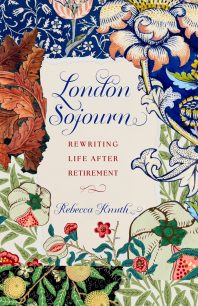
London Sojourn: Rewriting Life in Retirement (coming out January 27, 2025) is a memoir of my time in London. It’s the story of finding an identity as a writer and woman in England and returning to America with a rich trove of material. According to Ray Bradbury, writers need two kinds of material: first, experiences since birth, including one’s reactions to them, and second, experiences acquired through art and reading. All are stored in the mind as “fabulous” mulch. For two years, I’d enriched my mental and emotional soil: having experiences, taking classes, reading, listening, and tramping the streets. But England, it seems, was an intermediate place for me. I’ve since returned to London for rejuvenation and relaxation, but mostly nest in Portland, write, and enjoy being American.
REBECCA KNUTH is a retired professor and expert on censorship and cultural destruction. Formerly at the University of Hawaii, she authored Libricide: The Regime-Sponsored Destruction of Books and Libraries in the 20th Century and has contributed to Smithsonian Magazine, Cabinet, History News Network, CBC Radio, and more. Transitioning to creative nonfiction, she earned another master’s degree, her third, to add to her doctorate, and immersed herself in London’s literary scene. Now a full-time writer, she published Emily Dickinson Had to Have Curls in 2024. She lives in Portland, Oregon where she coordinated the Sylvia Beach Writers Conference as part of the Oregon Writers Colony. Learn more at rebeccaknuth.com
Meet the author at Annie Bloom’s event on February 5, 2026 at 7 pm.