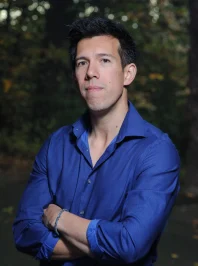
Daniel Tam-Claiborne; photo by George Orozco
In Daniel Tam-Claiborne’s Transplants, a chance encounter at a university campus in rural Qixian sets the lives of two young women on radically different trajectories: Lin, a reticent Chinese student who ends up matriculating at a community college in rural Ohio, and Liz, a grieving Chinese American ESL teacher who stays in China to learn more about the life her parents left behind. Over the course of a year, they learn what it means to be their truest selves in a world that doesn’t know where either of them belongs.
Daniel Tam-Claiborne is a multiracial writer, multimedia producer, and nonprofit director. A 2022 National Endowment for the Arts Literature Fellow, he has also received fellowships and residencies from the U.S. Fulbright Program, Poets & Writers, Bread Loaf Writers’ Conference, the Swatch Art Peace Hotel, and others. He is a frequent host and interlocutor in the Seattle literary community, moderating conversations with other authors including Lauren Groff, Garth Greenwell, and RF Kuang, for Elliott Bay Book Company, Seattle Arts & Lectures, Third Place Books, and the Seattle Public Library. He also serves on the Board of Directors of Seattle City of Literature.
Below, Tam-Claiborne shares insights into the writing and publishing of his novel, released May 13 by Regalo Press / Simon & Schuster. The novel was a finalist for the 2023 PEN/Bellwether Prize for Socially Engaged Fiction and a KUOW Book Club selection. This interview first appeared in the “Debut Diary” column of ALL ARTS.
To start off, how would you describe “Transplants” in three words?
“Lyrical, propulsive, coming-of-age”
 How did you arrive at the central questions and themes in your book? Were they something you had started with or were they revealed to you as you got deeper into the story?
The first inkling for the novel came over fifteen years ago, when I accepted a fellowship to teach English at a university in rural Shanxi Province, China, right after undergrad. As a mixed race Chinese American, I naively thought that the whole experience would be a chance to finally come to terms with my identity. But despite my best efforts at assimilating—marked by my passport and appearance—I remained, simply, a foreigner. While initially disappointed at my inability to cleave to a single sense of self, I realized that embracing this outside guise could also be a strength, enabling me to see my new world from a different perspective.
We often frame international education and cross-cultural exchange as a mutually beneficial experience for all parties involved. While I believe that’s generally the case, I also think there are exceptions. For years after, in spite of how undeniably positive the experience was on my own life, I found myself questioning the hierarchies that exist in cross-cultural settings—who gets to belong, who gets left behind, and how even fleeting encounters can alter someone’s trajectory forever. Those ideas are woven throughout Transplants.
What challenges (or triumphs!) did you meet while building out the book?
The novel was originally going to be set in the late 2000s, overlapping with my own time living and working in China. There was always going to be a quarantine element, which mirrored my own experience being in China during the H1N1 (swine flu) epidemic. But when the real-world pandemic hit, I decided to shift the timeline into the present. Writing about an unfolding crisis was unnerving, but it allowed me to explore themes of agency, migration, and power in a way that raised the stakes for my protagonists and kept me guessing what would happen next. It also underscored the underlying tensions at the heart of U.S.-China relations and the persistent precarity of Asian Americans as perpetual foreigners in this country.
Was there a moment when you realized you finished writing “Transplants”? How did it feel?
Since I was writing through much of the pandemic, I naively thought that the novel would end once the pandemic was “over.” Since that became less and less viable as a possibility, I knew that I had to cut myself off. While I hadn’t envisioned partitioning the novel into seasons, I began to see the utility of using a single year as a bookend. I wanted my characters to find some solace, even in a world that was—and still is—highly uncertain. Once they did, I knew that I could leave their stories for the time being.
And what do you hope readers feel or take away when they finish reading?
Asian Americans have long been perceived as strangers in America and the generational lines of our immigration journeys often complicate the perceptions that get applied broadly to all of us, irrespective of our individual ancestry. That question is further complicated by instances of misunderstanding or intolerance. It is hard to feel at home in a place where you are constantly scrutinized as an outsider and made to not feel welcome. Because so many of us live lives that are caught, precariously, between two continents, it’s all the more important that we have narratives that can normalize the complicated feelings that home elicits and provide a sense of belonging no matter where we are.
In a time of increased hostility between the U.S. and China, writing a book that is trying to bring a degree of humanity and empathy toward the people at the heart of this bilateral relationship increasingly feels like a political act. I hope readers will take away—if not greater appreciation—at least a more nuanced understanding and an openness to the experiences of individuals navigating these two countries and the possibility that our triumphs and challenges may be more shared than we currently envision.
What was your writing process like? Did you have any specific rituals?
I wrote the first drafts of this novel while I was still in my MFA program, and before my daughter was born, so I benefitted greatly from deadlines, accountability, and the long stretches of isolated time that came with the early months of the pandemic.
As a debut novelist, what surprised you about the publishing process?
How cathartic it was to kill my darlings! When my editor acquired my novel, she didn’t have much feedback on specific developmental edits, save for the fact that I needed to cut 15% of the words. This, naturally, terrified me, and for weeks I just stared at that line of feedback thinking it would be impossible to achieve. But when it came down to it, I actually reveled in trimming my book down. I kept a spreadsheet with the number of words in each chapter and how many I had cut after each successive draft. By the end, Transplants, which had started at just over 100k words, published at 85k, and I couldn’t be happier with how it turned out.
What is the biggest tip that you would give someone who is setting out to write their novel or published book?
My high school creative writing teacher, Jon Kawano, who got me—this stubborn wannabe engineer—to fall in love with writing, told us to “turn on your lights.” Most ideas and concepts have already been expressed, better and more eloquently, by writers who have come before. The only way to still come up with fresh ideas is to keep our eyes and senses open—to notice and record those things that most people miss or take for granted.
With writing can sometimes come rejection or moments of doubt. Have you faced this, and if so, how have you dealt with it?
It’s very rarely the most talented people who end up getting published, it’s who stays at the table longest. I’ve known many people who’ve stopped writing because of self-doubt. Transplants was rejected by dozens of imprints before finding a home. It was one of the most trying experiences for me as a writer, but I’ve come to learn to celebrate the wins. Not everything will work out as you plan, but taking stock of what went right (and thanking the people who got you there) will go a long way towards being able to see the process in a more positive light.
Finally, if you could place your book between two existing titles, what would they be?
“The Leavers” by Lisa Ko and “River East, River West” by Aube Rey Lescure.
Daniel Tam-Claiborne holds degrees from Oberlin College, Yale University, and the MFA Program for Writers at Warren Wilson College. Born and raised in Brooklyn, he lives with his wife and daughter in Seattle. He will be at Village Books in Bellingham for an event December 5 at 6 :00 PM with Diana Xin and Jane Wong. For more information, please visit his website, travelbreedscontent.com.